



Column
China’s "Peaceful Rise" policy: Economics over past conflict works


An Independent Newsweekly

Column
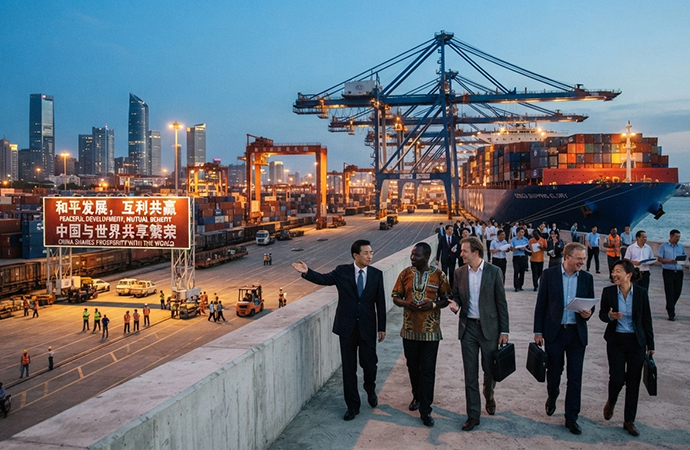
AI Generated Image
China has triumphed over history if one may say. Instead of past conflicts and legacies pulling the state down, China has chosen the future. It's a policy choice which would seem very unacceptable in South Asia where the present is all about the past conflicts and glory to justify its political existence at any given time.
This push for the future began under Deng Xiaoping in the 1980s and was formalised in the early 2000s under Hu Jintao. Chinese leadership recognised that political survival, poverty alleviation and socio-economic growth required stability at both the national and regional level.
Basically, it was a victory of common-sense in national politics. Holding grudges against political foes at home and abroad sound great while delivering slogans and making history the existential pillar. Terminating political opponents as a priority action display territorial or ideological dominance but not socio-economic development. China chose the latter.
Cultural Revolution and what followed
The Cultural Revolution which was led by current China's founder Mao and his radical comrades chose political activism as the primary goal of the state and the Communist Party. It was a period of chaos, economic structural collapse and a human rights violation.
It was hugely unpopular amongst all except among the party radical faction led by the "Gang of Four "as it became known as. It created politics but without economics so when Mao died in 1976 followed by the arrest of the Four, radicalism itself went on the retreat.
In 1978 PM Deng Xiaoping enacted the "Reform and Opening Up" policy. The policy platform was simple; China could not afford the economic drain of internal chaos and regional military conflicts. Therefore, national security policy was replaced by gross domestic product (GDP) growth and technological advancement as the priority. It changed the entire framework.
However, as China's economy grew, many including the West became suspicious and anxious. To diffuse this sense of global unease, China introduced the "Peaceful Rise" doctrine. It stated that China would break the historical cycle where rising powers used regional violence to ensure growth.
Main Policy pillars
The major components of the policy were the following:
* The "Good Neighbour" Policy: China settled several long-standing territorial disputes with Central Asian neighbours and lowering maritime disagreements in the South and East China Seas.
* Politics separated from Trade: China aggressively pursued Free Trade Agreements (FTAs) and economic pacts including with U.S. security allies and its own historical adversaries like Japan, South Korea and Australia.
* Asymmetric Economic Benefits: To gain confidence as trustworthy, China allowed regional partners to run massive trade surpluses with it. By acting as the primary buyer for regional goods, China transformed itself from a perceived military threat to the biggest regional economic buyer/power.
* Multilateral Institutional Integration: Instead of challenging regional blocs, China became an active participant and builders within them. It pushed the Regional Comprehensive Economic Partnership (RCEP) to anchor Southeast Asian economies to its market. It utilised the Shanghai Cooperation Organisation (SCO) to drive infrastructure stability in Central Asia.
Limitations of the new policy
China has gained much from its policy and so have its neighbours but there has been certain limitations of its policies too.
Analysts point out that the "open trade with all "policy may have made China rely more on Western-backed security frameworks to protect its global maritime trade routes. It also relies on a globalised supply chain for pushing its global trade policy. Assuming that trade will solve all issues is flawed as its relationship with old "foes" like Japan or India shows.
However, there are critics of this critique too. They state that no policy is a "solve all" policy for any country and most global policies of other states in comparison have suffered.
The economics over conflict is the only practical policy today and failure of the self-dependent ideological conflict is best seen in the US- Iran conflict which has damaged US's economics. image and global clout significantly.
Incidentally, China has gained most from this conflict depleting US's strategic arms arsenal and buying cheap oil from Iran.
The next stage
The policy that put "economics above all " may have served its purpose as China has emerged as the second largest global economic power with poverty almost gone and standard of living way higher than ever. China seems to have moved to the second stage.
This stage may be called the era of "National Rejuvenation" framework implementation. China is longer trying to build a stage to leap off but to consolidate. It has mixed economic engagement policies with a much more "assertive diplomatic posture" which has been called a "China First" strategy.
China hasn't abandoned economic diplomacy but has evolved it through large scale multi- sectoral infrastructure networks of which the Belt and Road Initiative (BRI) and the Asian Infrastructure Investment Bank (AIIB) are good examples. This policy lets it continue to push economic influence through trade and joint projects while taking care of its own national and resource security.
It's obvious that a global policy to success must be inclusive but the temptation to play the global security guard still remains high.
A Independent Newsweekly
© Copyright 2026 | Designed by ARK Reepon & Developed by Cosmos Group Software Team




Leave a Comment
Recent Posts
The government passes the test ...
One of the cornerstones of the political earthquake Bangladesh witness ...
The government hiked the price ...
The government hiked the price of a 12kg cylinder of liquefied petrole ...
Police in France stand accused of using excessive fo ..
The India-Pakistan Cold War
A week on from DNCC’s eviction drive, Mirpur-10 rema ..
Equal Service, Unequal Pensions: Time for a Fairer S ..